
 返回学校首页


 News
The 31st International Applied Geochemistry Symposium Held at CUGB
2026-09-21 Author:【深时数字地球前沿科学中心】 Views:0
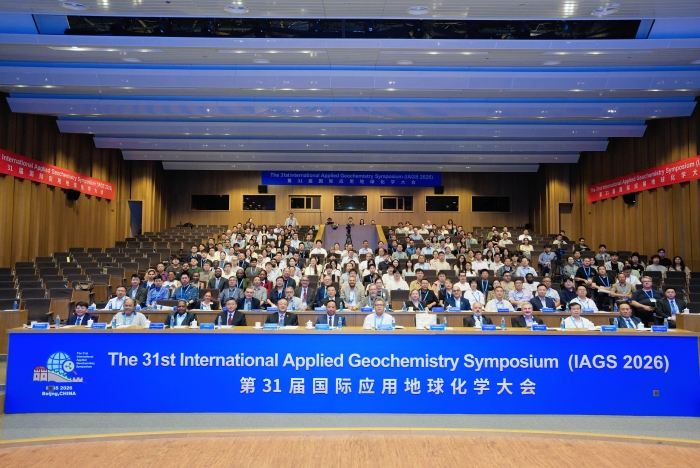
On September 13, 2026, the opening ceremony of the 31st International Applied Geochemistry Symposium (IAGS 2026) was held at China University of Geosciences (Beijing) (CUGB). Following the 16th IAGS in 1993, the symposium returned to China after 33 years. Hosted by the Association of Applied Geochemists (AAG) and organized by CUGB, the event was co-organized by the Institute of Geophysical and Geochemical Exploration, Chinese Academy of Geological Sciences, the UNESCO International Centre on Global-Scale Geochemistry, the UNESCO Chair on Deep-time Digital Earth and Mineral Resources, and other partners. Under the theme “Data-driven geochemical data mining in support of mineral exploration and environmental studies,” the symposium was chaired by Prof. Qiuming Cheng, Academician of the Chinese Academy of Sciences and professor at CUGB, who also presided over the opening ceremony.
Dr. Yalin Lei; Zhidan Zhao, President of CUGB; Dameng Liu, Vice President of CUGB; Shahbaz Khan, Director of the UNESCO Regional Office for East Asia; Haşim Ağrılı, Deputy Director General of Türkiye’s General Directorate of Mineral Research and Exploration; Ernest Mugandani, Deputy Director of the Geological Survey of Zimbabwe; Somthong Laolou, Deputy Director-General of the Department of Geology and Minerals of Laos; David Cohen, Treasurer of the International Union of Geological Sciences; Renguang Zuo, President of AAG; Xiongwei Zheng, Director of the Department of Science, Technology and Foreign Affairs of the China Geological Survey; Du Xiao, Director of the Institute of Geophysical and Geochemical Exploration, Chinese Academy of Geological Sciences; and academicians Fengchang Wu, Zengqian Hou, Jingwen Mao, Jun Deng and Ruizhong Hu attended related events. More than 300 delegates from 27 countries and regions registered for the symposium.
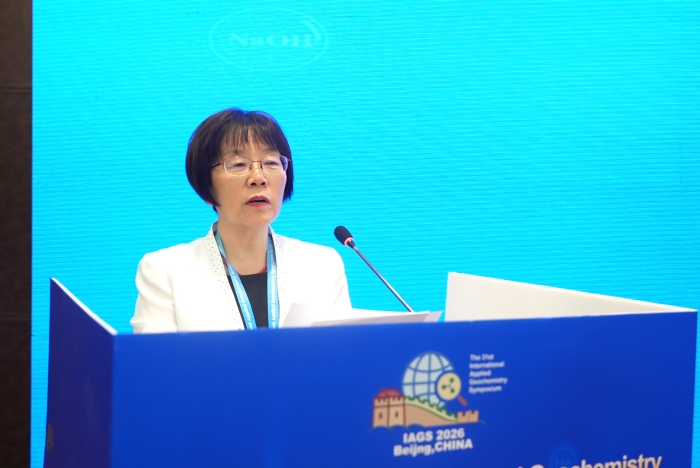
On behalf of the university, Lei extended a warm welcome to participants from Asia, Europe, Africa, North America, South America and Oceania. She introduced CUGB’s development, disciplinary strengths and achievements in international education, and expressed gratitude to AAG. Science knows no borders, she noted, adding that the advancement of Earth sciences requires the joint participation of scientists worldwide. She expressed the hope that the symposium would serve as a bridge for deeper exchange and mutual learning among international peers.
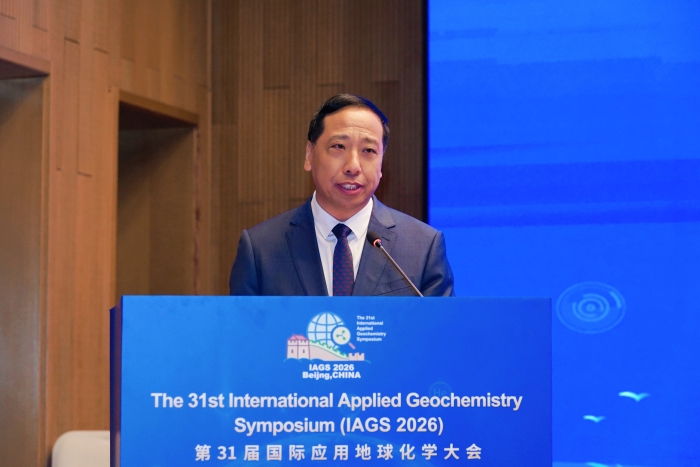
Zhao delivered opening remarks on behalf of the university. He said the theme of this year’s symposium was highly timely, highlighting the transformative role of data science and artificial intelligence in generating new discoveries and insights in geochemistry. He said, CUGB would take the symposium as an opportunity to further strengthen exchanges and cooperation with global partners and enhance the international influence of its geochemistry discipline.
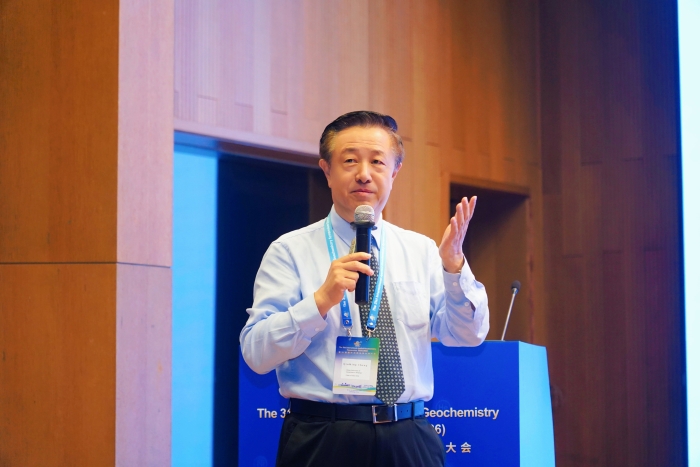
Academician Qiuming Cheng delivers a keynote lecture.
The four-day symposium featured 20 technical sessions, six keynote lectures, 105 oral presentations and 82 poster presentations. Topics covered artificial intelligence and machine learning, geochemical mapping, geohealth and the environment, mineralization and mineral exploration, showcasing the latest advances in geochemical research driven by big data and artificial intelligence. Keynote speakers included Academician Qiuming Cheng; Prof. Xueqiu Wang from the Institute of Geophysical and Geochemical Exploration, Chinese Academy of Geological Sciences; AAG Vice President Alexander Seyfarth; Prof. Cliff Stanley from Acadia University, Canada; Prof. Matthew Leybourne from Queen’s University, Canada; and Prof. Anna Ladenberger, former chair of the IUGS Commission on Global Geochemical Baselines. Their lectures addressed scientific foundation models and a new paradigm for quantitative geochemistry, geochemical mapping from the nano scale to the global scale, applications of X-ray spectroscopic methods in gold analysis, reference material analysis, isotope applications in mineral exploration, and challenges in mining and mineral exploration in Sweden.
Roundtable forums and the AAG awards ceremony were also held during the symposium. Experts and scholars from Colombia, Sweden, Canada, South Africa, China and other countries discussed the application of big data and machine learning in mineral exploration and environmental research, as well as ways to increase the participation and standing of women geoscientists in international scientific innovation and governance. Chinese scholar Xueqiu Wang and Canadian scholar Cliff Stanley received the 2024 and 2025 AAG Gold Medals respectively, while South Africa-based scholar John Carranza received the Silver Medal.
At the closing ceremony, the symposium released a series of research outcomes from Academician Qiuming Cheng’s team on a prediction model for deep-time extreme geological events based on singularity theory. By integrating singularity theory with artificial intelligence, the model can learn new insights from fragmented, incomplete and superimposed deep-time geological records, train micro-X-ray fluorescence foundation models, and support target delineation in 31 major metallogenic belts across 20 countries.
Applied geochemistry is a fundamental discipline supporting mineral resource exploration, energy resource assessment and ecological environmental protection. Founded in 1970, AAG convenes the International Applied Geochemistry Symposium every two years and co-publishes its flagship journal, Geochemistry: Exploration, Environment, Analysis, with the Geological Society of London. Chinese scholars, including academicians Xuejing Xie and Qiuming Cheng, Prof. Renguang Zuo and Prof. Xueqiu Wang, have received the AAG Gold Medal and have played an active role in international academic governance in the field.
The successful convening of IAGS 2026 reflects the international community’s recognition of China’s overall strength and organizational capacity in applied geochemistry, and demonstrates China’s leadership and global influence in data-driven geochemical research. Participants noted that the symposium provided a high-level platform for the global applied geochemistry community, further promoting the integration of big data, artificial intelligence and other emerging technologies with geochemistry, and offering stronger scientific and technological support for global resource and energy exploration, ecological environmental protection and sustainable development. Building on the symposium, CUGB will continue to deepen international exchanges and cooperation in Earth sciences, work with global partners to advance open sharing of geochemical data and methodological innovation, and contribute Chinese expertise and solutions to safeguarding national energy and resource security and serving global sustainable development.

Location:No. 29, Xueyuan Road, Haidian District, Beijing
All rights reserved by China University of Geosciences (Beijing)
LLocation:No. 29, Xueyuan Road, Haidian District, Beijing
Technical support: Information Network and Data Center
Official account
@Copyright: China University of Geosciences (Beijing)
