
 返回学校首页

 Academic Activities
Position:Home / COLLABORATION / Academic Activities
Academician Qiuming Cheng of CUGB Delivers Academic Report on the Deep-Time Digital Earth (DDE) Programme
2026-01-05 Author: Views:0
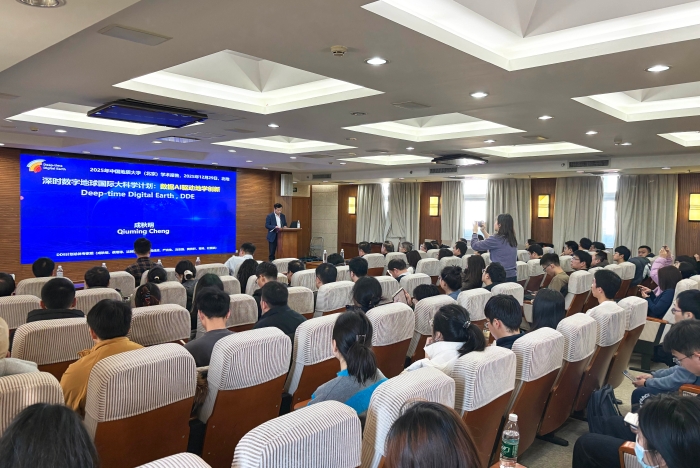
On the afternoon of 29 December, at the joint invitation of the Office of Science and Technology, Office of Human Resources, Graduate School of CUGB, and the MOE Frontier Science Center for Deep-Time Digital Earth, Academician Qiuming Cheng, Member of the Chinese Academy of Sciences, Chair of the Executive Committee and Head of the Overall Expert Panel of the Deep-Time Digital Earth (DDE) International Big Science Programme, and Professor of CUGB, delivered a cutting-edge academic report entitled Deep-Time Digital Earth International Big Science Programme: Data and AI-Driven Geoscience Innovation to faculty and students of the university. The report session was chaired by Professor Dameng Liu, Vice President of CUGB.
Professor Dameng Liu noted that the world has entered an era of big science, with increasing organization and collaboration in basic research. International big science programmes and projects are a key pathway to expanding the boundaries of human cognition, exploring the unknown world, and addressing major global scientific challenges, as well as an important reflection of a country’s comprehensive national strength and sci-tech innovation competitiveness. As the first international big science programme initiated and led by Chinese scientists, widely recognized by international organizations, and supported with official project approval by the Chinese government, the DDE Programme is of landmark significance for enhancing China’s sci-tech innovation competitiveness and driving the paradigm shift in geoscience research.
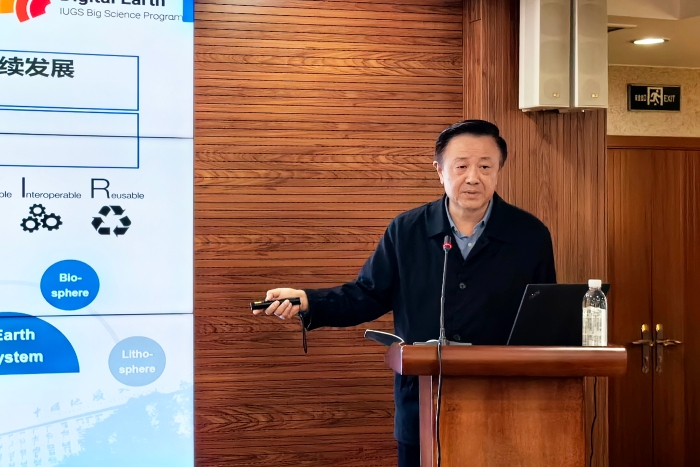
In the report, Academician Qiuming Cheng systematically elaborated on the cutting-edge trends of international geosciences, and provided an in-depth interpretation of the core mission and latest progress of the DDE Programme. He emphasized that the Earth system is a complex dynamic system formed by the interaction of multiple spheres, and uncovering its evolution laws is not only a frontier scientific exploration, but also a practical demand to support global sustainable development. Facing the opportunities and challenges brought by the era of big data, the geoscience research paradigm is undergoing a profound transformation: from the traditional “problem-driven”approach to a “data and knowledge-driven” approach, from reliance on “human brain intelligence” to “human-machine collaborative intelligence”, and the research path is also shifting from “seeking unknown answers to known questions” to “systematically discovering new scientific questions”. By coordinating global Earth evolution data and promoting geoscience knowledge sharing, the DDE Programme aims to advance original innovation in Earth system theory, serve the United Nations Sustainable Development Goals (SDGs), and lead geosciences into a new era of data and intelligence-driven development.
Academician Qiuming Cheng further introduced the specific layout and practical achievements of the DDE Programme in organized scientific research. Centering on the overall objectives of building global digital science and technology public goods, realizing original innovation in Earth system science, and supporting the United Nations Sustainable Development Goals (SDGs), the Programme has established ten landmark tasks, including: the International High-Precision Digital Geological Time Scale; Global Reconstruction of Plate Tectonics and Paleogeographic Evolution; Multi-Scale Geological Maps and High-Precision Geomorphic Maps; High-Resolution Multi-Proxy Deep-Time Earth Evolution Curves; Multi-Sphere Coupled Earth System Modelling; and Global Intelligent Prediction System for Resources, Energy and Disasters.
In terms of international cooperation, the DDE Programme has been officially incorporated into the framework of the United Nations Educational, Scientific and Cultural Organization (UNESCO) International Decade of Sciences for Sustainable Development (IDSSD), with 27 international organization members currently onboard. In addition, the MOE Frontier Science Center for Deep-Time Digital Earth hosted by CUGB, and the UNESCO Chair programme awarded to CUGB, have also provided critical support for the development and implementation of the DDE International Big Science Programme.
Over the past year, through in-depth engagement with institutions including the United Nations Educational, Scientific and Cultural Organization (UNESCO), the Coordinating Committee for Geoscience Programmes in East and Southeast Asia (CCOP), the Geological Society of Africa, and African geological survey authorities, as well as through presentations and exchanges at key platforms including the 2nd Belt and Road Conference on Science and Technology Exchange and the All-China Geosciences Union, the international recognition, influence and academic cohesion of the DDE Programme have continued to grow.
At the end of the report, Academician Qiuming Cheng shared the latest updates on the project deployment of the DDE Programme. He stated that in 2026, the DDE Programme will continue to uphold the concept of open cooperation, bring together global scientific forces, and jointly address global challenges such as resources, environment and disasters. The guidelines for the DDE Open Science Research Programme will be officially released on its official website in the near future, and Academician Qiuming Cheng encouraged all faculty and students of CUGB to actively follow the updates and participate in the application for relevant project tasks.

Location:No. 29, Xueyuan Road, Haidian District, Beijing
All rights reserved by China University of Geosciences (Beijing)

LLocation:No. 29, Xueyuan Road, Haidian District, Beijing
Technical support: Information Network and Data Center
Official account
@Copyright: China University of Geosciences (Beijing)
