
 返回学校首页

 News
News
Academician Qiuming Cheng of CUGB Leads Delegation to Advance Key Progress of the Deep-Time Digital Earth (DDE) Programme at the 30th African Geological Congress (CAG30)
2025-10-28 Author: Views:3
The 30th African Geological Congress (CAG30) was held in Nairobi, Kenya, from 23 to 27 September. Marking the 60th anniversary of the Geological Society of Africa and the 50th anniversary of the Geological Society of Kenya, the congress was themed Unlocking Africa’s Geological Resources: Forging a Path to Sustainable Development, and brought together nearly 400 geoscience experts from 38 countries worldwide.
At the invitation of the congress, Academician Qiuming Cheng from China University of Geosciences (Beijing) (CUGB), in his capacity as Chair of the Executive Committee and Head of the Overall Expert Panel of the Deep-Time Digital Earth (DDE) International Big Science Programme, led a CUGB delegation to attend the event. At the opening ceremony, Academician Cheng delivered an opening address, in which he systematically elaborated on the overall objectives and key progress of the DDE Programme, and clearly stated that the DDE Programme is committed to supporting Africa’s geoscience community in driving innovative development of geoscience research through data and artificial intelligence technologies. During the congress, the DDE Programme delegation actively participated in and organized multiple academic exchange events, further expanding and consolidating its cooperation network across Africa.
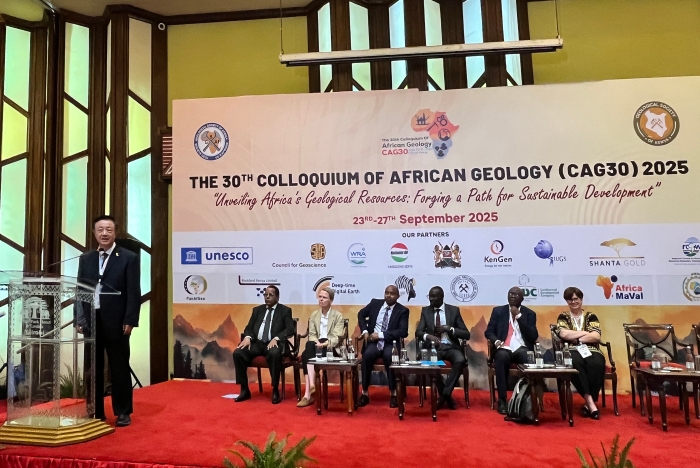
During the congress, the team from the DDE Programme led the organization of multiple academic events. The technical session on Application of Data and Artificial Intelligence in Geosciences, hosted by the DDE Programme, became one of the most influential academic events of the congress. At the UNESCO-IUGS African Geoscience Conference, Academician Qiuming Cheng systematically presented the measures taken by the DDE Programme to implement the recommendations from the November 2024 IUGS evaluation, so as to advance the next phase of development of the International Big Science Programme in a holistic manner.
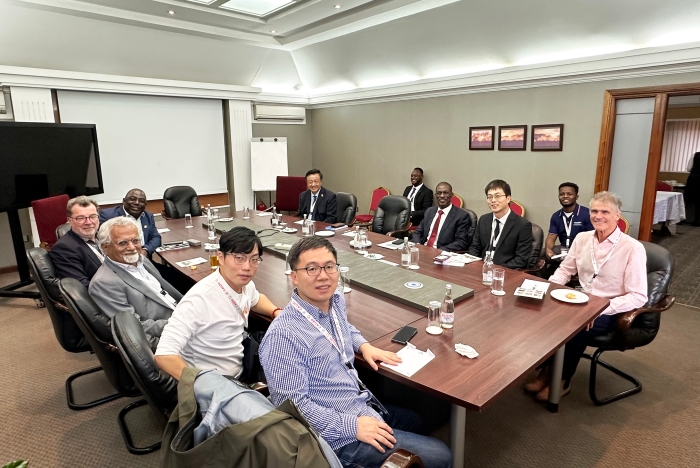
On the evening of 23 September, the DDE Programme successfully hosted the DDE/GeoGPT Business Meeting in Nairobi, bringing together partners from across the globe and Africa to discuss joint development. Discussions at the meeting focused on key topics including technical collaboration between the DDE and GeoGPT platforms, the development of global Centres of Excellence, and cooperation layout across Africa. Academician Qiuming Cheng introduced the organizational mechanism and open cooperation model of the DDE Programme, and emphasized the strategic direction of deepening cooperation in Africa. All participating delegates agreed that there is extensive demand for geoscience data and artificial intelligence platforms in Africa, and that the open ecosystem formed by the DDE Programme and GeoGPT is expected to provide critical support for regional scientific research capacity building.
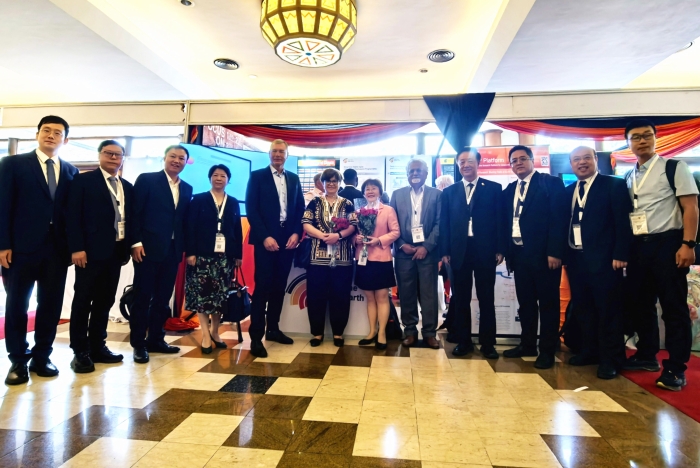
Professor Yalin Lei leads a delegation to visit the DDE booth and exchanges with DDE international experts.
Academician Qiuming Cheng also held in-depth discussions with Dr. Etienne Kadima Kabongo, Director of the University of Lubumbashi, on the first-year activity plan for the university’s DDE Centre of Excellence. The two parties agreed to jointly advance platform implementation and capacity building by leveraging CUGB’s MOE Frontier Science Center for Deep-Time Digital Earth, the DDEMR Chair, and the existing Africa-focused cooperation network of the DDE Programme.
In addition, on behalf of the Executive Committee of the DDE Programme, Academician Qiuming Cheng held bilateral talks with heads of geological survey institutions from multiple African countries. During the meeting with Ms. Anna Nguno, Deputy Director of the Geological Survey of Namibia (GSN), the two parties focused on exploring the potential for cooperation in the fields of geological mapping and artificial intelligence applications.
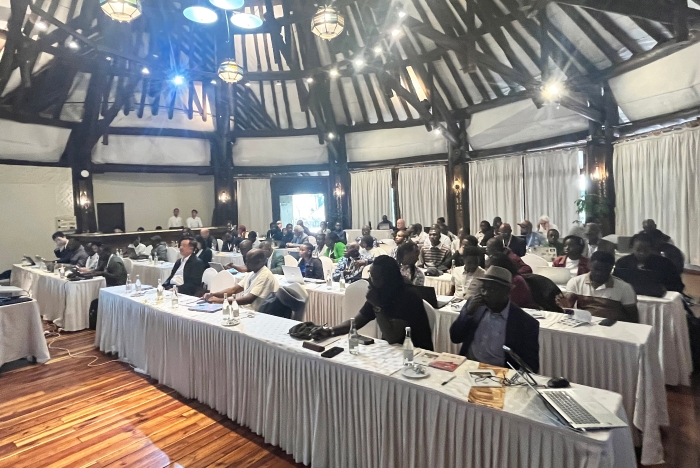
On 27 September, a full-day workshop on the DDE Programme Platform and GeoGPT was successfully held, attracting nearly 70 delegates, and became the most popular training event during the congress. Young scholars participated actively and put forward a number of suggestions on platform operation, localized promotion and capacity building, demonstrating the high level of attention from Africa’s geoscience community to open science tools.
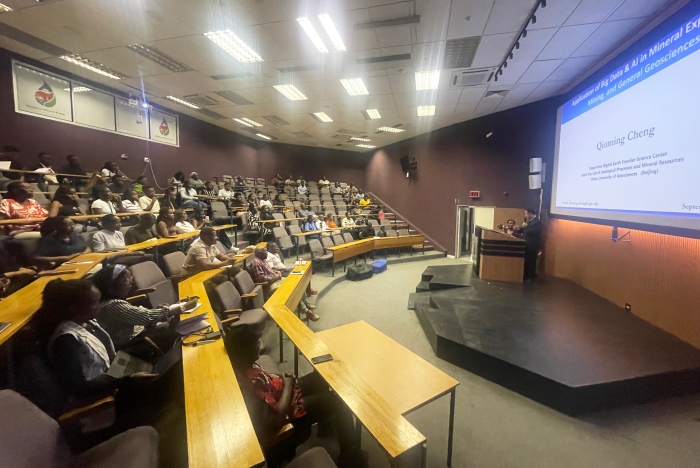
To deepen China-Africa geoscience cooperation, ahead of the opening of CAG30, Academician Qiuming Cheng and his delegation paid a visit to the Geological Survey of Namibia (GSN) from 18 to 22 September, where they met with Ms. Gloria Simubali, Director of GSN, and provided a comprehensive briefing to the bureau’s management team on the scientific objectives and implementation progress of the DDE Programme.
During the visit, Academician Qiuming Cheng was invited to deliver a keynote speech entitled Application of Big Data and Artificial Intelligence in Mineral Exploration, Mining and Geosciences. The speech, which incorporated practical case studies, received positive feedback from experts in attendance. The delegation also held exchanges with heads of professional organizations including the Women in Mining Association of Africa, the Hydrogeologists Association of Namibia, and the Namibian Geoscience Council, all of which expressed their willingness to participate in the cooperation.
This participation has effectively enhanced the visibility and influence of the DDE Programme within Africa’s geoscience community. Through multi-level academic exchanges and institutional matchmaking, the DDE Programme has further consolidated its cooperation mechanism in Africa, laying a solid foundation for future regional scientific research collaboration and capacity building. It also fully demonstrates the sense of responsibility, commitment and innovative leadership of Chinese scholars in global geoscience governance.
Background:
The Deep-Time Digital Earth (DDE) International Big Science Programme is the first international big science initiative led and initiated by Chinese scientists, with CUGB as the leading host institution (Official Website: ddeworld.org).
The African Geological Congress is the oldest and most influential geoscience academic conference on the African continent. First held in 1974, it has become a key platform for advancing the development of geosciences in Africa (Official Website: https://cag30nbi.org/).

Location:No. 29, Xueyuan Road, Haidian District, Beijing
All rights reserved by China University of Geosciences (Beijing)

LLocation:No. 29, Xueyuan Road, Haidian District, Beijing
Technical support: Information Network and Data Center
Official account
@Copyright: China University of Geosciences (Beijing)
